Last week (two weeks ago now, as our internet has been out for a week), the mission held a five-day seminar on transformational development. Mission members, the medical clinic staff, and many of the influential K’jong were invited to attend. Punctuality is not regarded as a virtue in Africa. Important people are actually supposed to arrive late, as their time is more valuable and they shouldn’t be kept waiting. The seminar was scheduled to begin at 10am, but everyone was told to arrive at 9am in hopes that we could begin an hour or so later (we began at 10am, and most people showed up by 11am). Greetings, snuff, and pre-pay phone cards were continually exchanged by all. Though the invitations clearly stated that individuals would not be paid for their attendance (people are sometimes paid to attend seminars in Uganda), when people realized that the mission actually meant what they said, a riot broke out. Lots of arguing and shouting about how they should be paid (obviously the very word “workshop” implies that they should be paid, no?), until almost all of the room walked outside to discuss it. The mission provided lunch, but that wasn’t good enough either, because they wanted sodas and chicken (extravagances that are not provided at other workshops either). I was surprised to see how many people returned on Tuesday, and it went much smoother thereafter, at least until the argument was resumed Friday afternoon. I think we lost a few of the most belligerent individuals.
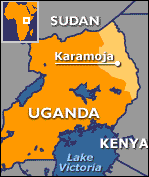
Over the years, incredible amounts of aid money have flowed into Karamoja, yet there’s very little to show for it. Programs collapse, NGOs leave, and the locals are no better (and arguably worse) off than previously. Although World Food can be an important resource, their presence and donations provide little motivation for the K’jong to do their own planting – why bother, if you know someone else will do the work for you? Transformational development is essentially the concept of sustainable changes initiated at a grassroots level; the idea that the locals must take responsibility for their problems and act to resolve them. In Karamoja, this really is a foreign concept. The culture is very fatalistic; the K’jong don’t believe that there can or will be any improvement in their situations, and certainly don’t believe they can do anything about it. They believe that there is a limited amount of wealth, and that if someone has more than you do, than he’s taken your share of it, so it’s only fair for you to take it back. The basis of the conference was getting people to recognize that they were made in the image of God, and therefore have the intelligence and ability to think, make decisions, and take control of their situations – that they are capable of solving some of their own problems. For example, if food shortage is an issue, plan ahead and plant crops instead of relying solely on World Food or theft (although the culture is so depraved that people cannot save/store anything, as it will be stolen by their neighbors or relatives). When asked to evaluate negative aspects of their communities, the list was extensive: drunkenness (much of the population is seriously alcoholic), poverty, violence, ignorance, theft… When asked to name the positive aspects, most laughed and replied “emam” – they saw nothing good at all. The positives actually came from the missionaries, one of which broke out in tears as she described the compassion she had witnessed by the K’jong towards the weak: the blind and crippled are accepted and integrated into the community (Loduk Albino had polio as a child and cannot walk, but is respected and has five beautiful children), warriors carry their infants to the clinic for medical care, some of the K’jong have picked up or cared for the missionary’s own crying children.
I have no idea what will come of the conference, but it’s at least a start. Some of the K’jong were shocked to find that they could actually have a conversation with a mizungu (white person), and a woman pointed at me as she explained that the Picot (another tribe) and mizungus were no longer enemies. Small steps.
skip to main |
skip to sidebar



Blog Archive
About Me
'For the earth will be filled with the knowledge of the glory of the LORD as the waters cover the sea."
- Habakkuk 2:6
- Habakkuk 2:6
No comments:
Post a Comment