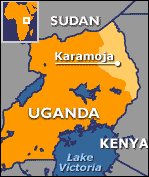
It’s been an interesting past week – certainly the most tense I’ve experienced here yet. One of the nursing assistants was found to be drunk while on duty, and was subsequently released. This man was the last professional K’jong employee working at the clinic (the rest have been fired for theft/drunkenness or have gone on to do further schooling or better paying positions, so the staff is composed primarily of Ugandans from other regions), and the community was incensed at his termination. They insisted that either the man be reinstated or that we remove our clinic administrator as well, as they inaccurately blamed her for the decision. When their demands were not met, they responded by blocking the gates with thorn bushes to prevent anyone from entering or leaving the clinic. The clinic had already been closed for the week as it was short-staffed and one of the water pipes broke, but the act was nevertheless alarming. A community meeting including the local villages, mission staff, and the Local Counselors (LCs, elected officials with varying degrees of responsibility for a small area) was held on Thursday in hopes of clarifying and correcting false accusations and understandings. The five-hour meeting became a mob forum, in which mission members were accused of being “Satan”, etc, and one individual suggested that all the non-K’jong – mizungus and Ugandans alike – be ‘chased’ from Karamoja. The meeting ended with the LC3 suggesting that the clinic administrator be allowed to stay in Karamoja, but that she be given other work. Immediately afterwards, the K’jong smiled and shook hands with mission members, saying that everything was fine now; they had vented and said their piece, and now it was over.
The mission cannot run the clinic while being subjected to mob rule, and said as much to the LC the following day. At this point, he completely switched positions and said that the mission was absolutely free to do what they thought was right and appropriate, and that it was no problem for the administrator to remain in her position. Some Africans seem to have a knack of communicating whatever they think you want to hear, both to us and to each other, so it’s impossible to know his actual thoughts, but he’s willing to put this in writing. Mission members have spent the past several days meeting with village elders and some of the more outspoken critics. These smaller discussions have given a very different perspective on what happened. The elders are actually very supportive of the mission and the clinic; they have no desire to see anyone leave. One had tried to speak at the meeting several times, but was repeatedly shouted down or pushed aside. We learned that the most belligerent individuals were not even from the local area, and that the dismissed employee had actually paid villages to attend the meeting. The situation has calmed tremendously, and the clinic will hopefully open again next week.
Monday, May 4, 2009

Saturday, April 25, 2009
Went to Kopetatum again this morning. The villagers were expecting us, but when we arrived, almost no adults were seen (I think I’ve been here too long – if that’s Ugandan English, sorry, I can’t remember and it sounds normal to me). We learned that an aid agency is distributing seeds and hoes in the town 10k away, so everyone had gone to collect their share. As there were no opportunities for mudding the bandas today, we instead followed Rose out into the bush (a group of children following us), where she started hacking at a thorn tree with an axe. She asked whether we understood and could use the axe – most of us are obviously not known for our construction abilities. We cringed at the idea of cutting down the trees, as they are relatively scarce in the savannah and reforestation is a foreign concept, but complied. The thorn branches are used to form protective fences around the manyattas, meaning that they must be literally dragged back to the village by foot. The trees aren’t so large, but this still requires a good deal of muscle as the thorns catch everything in their path. After making several trips with the thorn trees, Emily and I were worn out, so we followed Sagal and Logit, two K’jong girls (maybe eight- and five-years-old), to the river to collect water. We’re into the beginning of the wet season, but the ground has been so dry that it’s still absorbing almost all of the rain. The “river” is actually just sand at this point. The K’jong dig into the riverbed to access whatever groundwater they can find. There were several pits about two feet deep, the largest holding maybe two liters of water. Sagal removed the standing water with a can, tossing it outside the pit. This apparently removes some of the murkier water. The pit slowly refilled, and we scooped water into their jerrycans. I was thirsty and would have happily accepted the offered drink, but as of yet have no desire to host amoebas or other parasites. Emily and I carried the containers back up to the bank. The girls cleaned the sand off the bottom of the jerrycans so that Em and I could carry them in true K’jong fashion: on our heads. Women here are incredibly strong and carry all sorts of things on their heads (grain sacks, wood piles, etc.) that would likely break my neck. Our jerrycans don’t really compare, but we were still quite pleased to have managed it.
Tuesday, April 7, 2009
One of the local villages burned down a few weeks ago. The men were having a goat roast, but it got out of control and the entire (thatch) village went up in flames. They’ve been given financial/material assistance from the government, and we wanted to do something that showed Christ to the community and involved more than handouts. The pastors organized a workday this morning with the villages, so about seven of us went to Kopetatuum this morning to help rebuild the village. Though some construction has happened since the fire, it’s been delayed by the dry season as the ground couldn’t be hoed (dirt is a necessary component) until the rains began this week. When I arrived, a woman indicated that she wanted my help, so I followed her to her hut. The K’jong think that mizungu women are utterly helpless and incapable of doing anything – we can’t build, can’t carry anything on our heads (much less the 50 pound loads they manage), can’t cook properly… This supposition was strongly affirmed when the woman asked whether I knew how to thatch the roof (no), make mud for the walls (no), or frame the banda (no). Of course, she doesn’t speak English and my K’jong is limited to about ten phrases, so this exchange is communicated through unintelligible words, tone of voice, facial expressions, and hand gestures. It was remarkably clear. I told her that I didn’t know how to do anything, but that I would do anything she showed me. So I held sticks together while Rose tied them with bark strips around the perimeter of the circular banda to construct the frame. She later led me to another hut, where we mixed mud – remarkably similar to kneading bread – and then her daughter and I mudded the inside walls. Mudding requires bringing jerrycans full of soil and water to the ere, which is no small task considering the lack of plumbing and machinery. Everything is carried and mixed by hand. The mixture is applied to the wall by throwing chunks of mud into the chinks and then packing and smoothing it. We had fun. I was filling in the bottom while Lolem Keris was fling mud towards the top, so I ended up with a good deal of mud in my hair and everywhere else. Several people came by while we were working and said “Ejok etic!” (good work!). They were astonished to see the mizungus voluntarily working alongside them and asking nothing in return. They were genuinely appreciative of the help and we enjoyed it too. We’re making plans to return in the near future. Still haven’t managed to extract all the dirt from under my nails.
Thursday, March 19, 2009
Oh, Africa! I was accosted by one of our near neighbors as I walked by on my way to the clinic. He questioned my pace and then publically derided me for not having stopped to literally greet and shake hands with each of the thirty men loafing on the side of the road. I was informed that my general greeting to the group was offensive, and that by waving, I implied that the men were “lions or goats”. I tried to apologize and make amends, but the man was adamant and continued with his tirade. Aghh! Maybe I’m misinterpreting the situation, but I think he was relishing the opportunity to lecture an outsider. After seeing a Kenyan friend wave to a K’jong in the clinic without any adverse reaction, I questioned her about my encounter. I want to adjust to their culture and know I can’t expect them to know ours, but also have absolutely no desire to spend ten minutes greeting a group of strangers while I’m trying to reach a destination. She assured me that the man was just being difficult. She knows him too. One of the nurses came over to greet me and proceeded to tell me, in a very cheery voice, how fat I looked today. Thanks. I knew she meant it to be a complement, so wasn’t as offended as I would have been earlier this year. People here think so differently, and I’m only beginning to understand it. We’re quoted the mizungu price when we’re purchasing most items. The price is typically ridiculous, and though the Africans expect to be haggled with, if an unwary consumer happens to agree, then all the more reason for celebration. I equate this with robbery, but the Africans see it very differently – rich people are supposed to pay more than the poor. It’s just the way things are. (I’ll admit to having similar feelings about Kansas’ traffic tickets.) Once I understand their reasoning, I’m much better able to accept and adapt. The trouble is making it out. Slowly by slowly.
Wednesday, February 18, 2009
Last week (two weeks ago now, as our internet has been out for a week), the mission held a five-day seminar on transformational development. Mission members, the medical clinic staff, and many of the influential K’jong were invited to attend. Punctuality is not regarded as a virtue in Africa. Important people are actually supposed to arrive late, as their time is more valuable and they shouldn’t be kept waiting. The seminar was scheduled to begin at 10am, but everyone was told to arrive at 9am in hopes that we could begin an hour or so later (we began at 10am, and most people showed up by 11am). Greetings, snuff, and pre-pay phone cards were continually exchanged by all. Though the invitations clearly stated that individuals would not be paid for their attendance (people are sometimes paid to attend seminars in Uganda), when people realized that the mission actually meant what they said, a riot broke out. Lots of arguing and shouting about how they should be paid (obviously the very word “workshop” implies that they should be paid, no?), until almost all of the room walked outside to discuss it. The mission provided lunch, but that wasn’t good enough either, because they wanted sodas and chicken (extravagances that are not provided at other workshops either). I was surprised to see how many people returned on Tuesday, and it went much smoother thereafter, at least until the argument was resumed Friday afternoon. I think we lost a few of the most belligerent individuals.
Over the years, incredible amounts of aid money have flowed into Karamoja, yet there’s very little to show for it. Programs collapse, NGOs leave, and the locals are no better (and arguably worse) off than previously. Although World Food can be an important resource, their presence and donations provide little motivation for the K’jong to do their own planting – why bother, if you know someone else will do the work for you? Transformational development is essentially the concept of sustainable changes initiated at a grassroots level; the idea that the locals must take responsibility for their problems and act to resolve them. In Karamoja, this really is a foreign concept. The culture is very fatalistic; the K’jong don’t believe that there can or will be any improvement in their situations, and certainly don’t believe they can do anything about it. They believe that there is a limited amount of wealth, and that if someone has more than you do, than he’s taken your share of it, so it’s only fair for you to take it back. The basis of the conference was getting people to recognize that they were made in the image of God, and therefore have the intelligence and ability to think, make decisions, and take control of their situations – that they are capable of solving some of their own problems. For example, if food shortage is an issue, plan ahead and plant crops instead of relying solely on World Food or theft (although the culture is so depraved that people cannot save/store anything, as it will be stolen by their neighbors or relatives). When asked to evaluate negative aspects of their communities, the list was extensive: drunkenness (much of the population is seriously alcoholic), poverty, violence, ignorance, theft… When asked to name the positive aspects, most laughed and replied “emam” – they saw nothing good at all. The positives actually came from the missionaries, one of which broke out in tears as she described the compassion she had witnessed by the K’jong towards the weak: the blind and crippled are accepted and integrated into the community (Loduk Albino had polio as a child and cannot walk, but is respected and has five beautiful children), warriors carry their infants to the clinic for medical care, some of the K’jong have picked up or cared for the missionary’s own crying children.
I have no idea what will come of the conference, but it’s at least a start. Some of the K’jong were shocked to find that they could actually have a conversation with a mizungu (white person), and a woman pointed at me as she explained that the Picot (another tribe) and mizungus were no longer enemies. Small steps.
Over the years, incredible amounts of aid money have flowed into Karamoja, yet there’s very little to show for it. Programs collapse, NGOs leave, and the locals are no better (and arguably worse) off than previously. Although World Food can be an important resource, their presence and donations provide little motivation for the K’jong to do their own planting – why bother, if you know someone else will do the work for you? Transformational development is essentially the concept of sustainable changes initiated at a grassroots level; the idea that the locals must take responsibility for their problems and act to resolve them. In Karamoja, this really is a foreign concept. The culture is very fatalistic; the K’jong don’t believe that there can or will be any improvement in their situations, and certainly don’t believe they can do anything about it. They believe that there is a limited amount of wealth, and that if someone has more than you do, than he’s taken your share of it, so it’s only fair for you to take it back. The basis of the conference was getting people to recognize that they were made in the image of God, and therefore have the intelligence and ability to think, make decisions, and take control of their situations – that they are capable of solving some of their own problems. For example, if food shortage is an issue, plan ahead and plant crops instead of relying solely on World Food or theft (although the culture is so depraved that people cannot save/store anything, as it will be stolen by their neighbors or relatives). When asked to evaluate negative aspects of their communities, the list was extensive: drunkenness (much of the population is seriously alcoholic), poverty, violence, ignorance, theft… When asked to name the positive aspects, most laughed and replied “emam” – they saw nothing good at all. The positives actually came from the missionaries, one of which broke out in tears as she described the compassion she had witnessed by the K’jong towards the weak: the blind and crippled are accepted and integrated into the community (Loduk Albino had polio as a child and cannot walk, but is respected and has five beautiful children), warriors carry their infants to the clinic for medical care, some of the K’jong have picked up or cared for the missionary’s own crying children.
I have no idea what will come of the conference, but it’s at least a start. Some of the K’jong were shocked to find that they could actually have a conversation with a mizungu (white person), and a woman pointed at me as she explained that the Picot (another tribe) and mizungus were no longer enemies. Small steps.
Saturday, February 7, 2009
I’m continuing to enjoy life here. I’m trying to be brave. Things happen that I would freak out about at home, but here, you just have to suck it up and be okay. Like when I was a counselor at a junior high camp and we had mice in the cabin, and I just had to be the adult and pretend everything was okay, and eventually it becomes that way. Last week, I was going out to use the latrine before I went to bed. Turned on the light, opened the door, and saw a rat running around inside. I shut the door and went to use one of the inside bathrooms instead, resolving to just deal with it in the morning (meaning get someone else to deal with it in the morning), but then realized that would need to use the latrine before the rat was removed. So got my flashlight and searched the compound for one of our guards, and managed to communicate enough that he followed me to the latrine with his bow and arrow (they don’t really speak English). I don’t know if he understood that I was trying to get him to kill a rat, but he certainly figured it out as soon as we got there. I didn’t watch, but he took care of it and signaled to me that it was done. I was trying to call one of the cats over to come and take the body, but the guard motioned that this wouldn’t be a possibility, as the rat had gone down into the latrine pit. At this point, I tried to find out whether the rat was actually dead or whether he was going to crawl out at a most inopportune moment (all done with hand signals), and the guard drew his finger across his throat and taught me the K’jong word for “dead” or “killed” or similar (I don’t know the particular meaning, but certainly got the gist of it). Anyways, yet another interesting cross-cultural experience.
Saturday, January 24, 2009
Went to the Entebbe zoo (outside the capital city of Kampala) this week. Was annoyed upon entry, because had been required to pay 4x the admission price of the locals, and then sent back to pay for use of my camera. After that, things vastly improved. The zoo definitely would not have measured up to US safety standards. Because of that, it was fabulous. We were able to get so much closer to the animals than we would have at home. I could have touched the ostriches and monkeys if I had any desire to, and could have easily joined the lion in his habitat. If people exercise common sense, no problems, but if you were of a mind to do something stupid, you’re going to suffer for it. I saw an empty cage, covered with ivy and vines. Obviously hadn’t been used in awhile. I was told that it formerly housed the monkeys, but they had reproduced quickly and surpassed the capacity of the cage. So instead of building a larger cage, they now have run of the park. It was awesome. The monkeys came within a couple feet of us, and we were able to watch them playing, fighting, eating… I got some really good pictures. Some of the kids around us were edging up to the monkey (one of our party heard the father encouraging his son to touch the animal, assuring him that it was quite safe). When the monkey decided that the kid had gotten close enough, it turned, snarled, and chased the kid across the field. The kid was fine, and I laughed. I kept my distance. Yes, the monkeys are used to people, but they’re definitely not tame.
The next day, spent the afternoon at the Kampala amusement park (we’re kind of on vacation). Admission is the equivalent of $3 USD, and can’t imagine how they’re staying out of the red. The city electricity occasionally goes out, meaning that the business must run a generator to operate the rides. Let me tell you, this is nothing like Worlds of Fun. The Octopus (that spinning ride that goes up and down) is made much more exciting simply because it’s in Africa, and I somehow doubt whether their safety precautions would make par in the States. I’m not disappointed. The arm (or tentacle, if we’re going to be technical) of my cart sounds and feels as though it is popping in and out of joint. After a few minutes, I hear my friend shouting “Stop! Stop!”. The operator finally tunes in and slows the ride to a halt. I assume my friend can’t handle the spinning and is feeling nauseous. Wrong. Her safety bar had suddenly released, and she couldn’t get it to latch and was beginning to slide out the side. We had fun, we’re all fine, it’s just crazy different here.
The next day, spent the afternoon at the Kampala amusement park (we’re kind of on vacation). Admission is the equivalent of $3 USD, and can’t imagine how they’re staying out of the red. The city electricity occasionally goes out, meaning that the business must run a generator to operate the rides. Let me tell you, this is nothing like Worlds of Fun. The Octopus (that spinning ride that goes up and down) is made much more exciting simply because it’s in Africa, and I somehow doubt whether their safety precautions would make par in the States. I’m not disappointed. The arm (or tentacle, if we’re going to be technical) of my cart sounds and feels as though it is popping in and out of joint. After a few minutes, I hear my friend shouting “Stop! Stop!”. The operator finally tunes in and slows the ride to a halt. I assume my friend can’t handle the spinning and is feeling nauseous. Wrong. Her safety bar had suddenly released, and she couldn’t get it to latch and was beginning to slide out the side. We had fun, we’re all fine, it’s just crazy different here.
Wednesday, January 7, 2009
This time, the shepherd boys did start the fire. We had smelled the burning for a while, but didn’t think much of it, as this sort of thing happens frequently. When we walked out of the house, we heard crackling and saw the fields backing up to the house consumed by smoke and flames. The wind blew towards the compound, carrying soot and pushing the fire towards the houses (which, thank God, have very little wood because of the tenacious termites). So much smoke was in the air that it filtered the sunlight, creating an eerie orange glow on the ground. For the past six weeks, we’ve had 90-105ºF temperatures, no rain, and a lot of wind. In other words, ideal conditions for a wildfire. The fire covered a great area, but it’s not like Karamoja has city plumbing or a fire department – there’s not much you can do but watch.
When the blaze reached the edge of the compound, everyone (K’jong and American, adults and children) wrenched branches from the trees and began beating the flames. I used to think that dying from smoke inhalation would be relatively painless, like carbon monoxide. Not true. The smoke burned my eyes and throat, so that I couldn’t last more than twenty seconds stints before retreating to less polluted air. No later would we finish putting out one section and move to another than the original would relight. The blaze finally burned itself out, having used all available fuel, though we can still see it raging in the distance. Can seriously see the hand of God in this: the fire hit all four sides of our compound, but was never able to sustain itself within the perimeter. It also seems to be heading away from the villages, which otherwise would certainly burn to the ground (mud and thatch aren’t the most durable materials). Everyone smells like smoke, but is otherwise fine. Our fields are charred black, but next time, there shouldn’t be much else to burn.
When the blaze reached the edge of the compound, everyone (K’jong and American, adults and children) wrenched branches from the trees and began beating the flames. I used to think that dying from smoke inhalation would be relatively painless, like carbon monoxide. Not true. The smoke burned my eyes and throat, so that I couldn’t last more than twenty seconds stints before retreating to less polluted air. No later would we finish putting out one section and move to another than the original would relight. The blaze finally burned itself out, having used all available fuel, though we can still see it raging in the distance. Can seriously see the hand of God in this: the fire hit all four sides of our compound, but was never able to sustain itself within the perimeter. It also seems to be heading away from the villages, which otherwise would certainly burn to the ground (mud and thatch aren’t the most durable materials). Everyone smells like smoke, but is otherwise fine. Our fields are charred black, but next time, there shouldn’t be much else to burn.
Subscribe to:
Posts (Atom)