Saturday, April 25, 2009
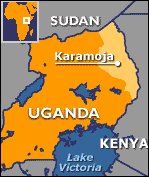
Went to Kopetatum again this morning. The villagers were expecting us, but when we arrived, almost no adults were seen (I think I’ve been here too long – if that’s Ugandan English, sorry, I can’t remember and it sounds normal to me). We learned that an aid agency is distributing seeds and hoes in the town 10k away, so everyone had gone to collect their share. As there were no opportunities for mudding the bandas today, we instead followed Rose out into the bush (a group of children following us), where she started hacking at a thorn tree with an axe. She asked whether we understood and could use the axe – most of us are obviously not known for our construction abilities. We cringed at the idea of cutting down the trees, as they are relatively scarce in the savannah and reforestation is a foreign concept, but complied. The thorn branches are used to form protective fences around the manyattas, meaning that they must be literally dragged back to the village by foot. The trees aren’t so large, but this still requires a good deal of muscle as the thorns catch everything in their path. After making several trips with the thorn trees, Emily and I were worn out, so we followed Sagal and Logit, two K’jong girls (maybe eight- and five-years-old), to the river to collect water. We’re into the beginning of the wet season, but the ground has been so dry that it’s still absorbing almost all of the rain. The “river” is actually just sand at this point. The K’jong dig into the riverbed to access whatever groundwater they can find. There were several pits about two feet deep, the largest holding maybe two liters of water. Sagal removed the standing water with a can, tossing it outside the pit. This apparently removes some of the murkier water. The pit slowly refilled, and we scooped water into their jerrycans. I was thirsty and would have happily accepted the offered drink, but as of yet have no desire to host amoebas or other parasites. Emily and I carried the containers back up to the bank. The girls cleaned the sand off the bottom of the jerrycans so that Em and I could carry them in true K’jong fashion: on our heads. Women here are incredibly strong and carry all sorts of things on their heads (grain sacks, wood piles, etc.) that would likely break my neck. Our jerrycans don’t really compare, but we were still quite pleased to have managed it.

Tuesday, April 7, 2009
One of the local villages burned down a few weeks ago. The men were having a goat roast, but it got out of control and the entire (thatch) village went up in flames. They’ve been given financial/material assistance from the government, and we wanted to do something that showed Christ to the community and involved more than handouts. The pastors organized a workday this morning with the villages, so about seven of us went to Kopetatuum this morning to help rebuild the village. Though some construction has happened since the fire, it’s been delayed by the dry season as the ground couldn’t be hoed (dirt is a necessary component) until the rains began this week. When I arrived, a woman indicated that she wanted my help, so I followed her to her hut. The K’jong think that mizungu women are utterly helpless and incapable of doing anything – we can’t build, can’t carry anything on our heads (much less the 50 pound loads they manage), can’t cook properly… This supposition was strongly affirmed when the woman asked whether I knew how to thatch the roof (no), make mud for the walls (no), or frame the banda (no). Of course, she doesn’t speak English and my K’jong is limited to about ten phrases, so this exchange is communicated through unintelligible words, tone of voice, facial expressions, and hand gestures. It was remarkably clear. I told her that I didn’t know how to do anything, but that I would do anything she showed me. So I held sticks together while Rose tied them with bark strips around the perimeter of the circular banda to construct the frame. She later led me to another hut, where we mixed mud – remarkably similar to kneading bread – and then her daughter and I mudded the inside walls. Mudding requires bringing jerrycans full of soil and water to the ere, which is no small task considering the lack of plumbing and machinery. Everything is carried and mixed by hand. The mixture is applied to the wall by throwing chunks of mud into the chinks and then packing and smoothing it. We had fun. I was filling in the bottom while Lolem Keris was fling mud towards the top, so I ended up with a good deal of mud in my hair and everywhere else. Several people came by while we were working and said “Ejok etic!” (good work!). They were astonished to see the mizungus voluntarily working alongside them and asking nothing in return. They were genuinely appreciative of the help and we enjoyed it too. We’re making plans to return in the near future. Still haven’t managed to extract all the dirt from under my nails.
Subscribe to:
Posts (Atom)